

“Mastery is always better” is tidy advice, and it’s wrong often enough to cause trouble.
A team can spend weeks improving its process, refining its craft, and learning from every mistake while a client waits, a campaign misses its commercial target, or a competitor wins the account. Performance goals can create pressure, but they can also force decisions, sharpen priorities, and make results visible to people outside the team.
The practical answer isn’t choosing one camp. It’s building a goal profile that tells people what they need to learn and what they must deliver. That distinction matters for small businesses, where the same person may need to develop a skill on Monday and defend a measurable client outcome on Friday.
Why the Mastery vs Performance Goals Debate Matters More Than You Think
Online articles and social media posts often frame the mastery vs performance debate as a morality play. Mastery sounds thoughtful and sustainable. Performance sounds shallow, stressful, or toxic. That framing is easy to repeat and poor management advice for owners who must balance staff development with client judgments, deadlines, and commercial results.
In achievement goal theory, the distinction emerged in the late 1980s. Mastery goals focus on improving competence and understanding, while performance goals focus on demonstrating competence relative to other people, as summarized in the classroom research literature (Journal of Educational Research study). In a business, that difference affects onboarding plans, feedback, hiring reviews, and quarterly targets.
A mastery-focused onboarding plan might ask a new designer to learn the company’s research process and explain design decisions more clearly. A performance-focused plan might ask that designer to complete client work faster than colleagues or meet a visible delivery target. Both communicate what the business values, but they create different pressure.
Practical rule: If your team cannot tell whether success means “get better” or “prove the result,” the manager has created a goal problem, not an employee problem.
Where the popular advice breaks
Pure mastery framing has a quiet failure mode. It can give people permission to keep learning while the market, client, or owner needs a decision now. A team may become skilled at discussing experiments without shipping the landing page. It may improve internal standards while missing the retention target that determines whether the client renews.
That does not make mastery goals bad. A classroom study found that mastery goals supported motivation and test performance, while goal orientations differed substantially among individuals rather than being fixed by classroom context (classroom achievement goal research). The practical lesson is clear: people do not all respond to the same framing, and context changes what a goal needs to do.
Your company mission can give the team a reason to care, but it cannot replace operating targets. Owners connecting purpose with execution can use this company mission statement resource as a starting point, then translate the mission into learning objectives and externally visible outcomes.
Ask two questions: What does this person need to improve, and what result will prove that improvement matters? That combination is more useful than choosing mastery or performance as a permanent philosophy.
Defining Mastery and Performance Goals in Plain English
A mastery goal tells someone to improve their capability. It points attention toward learning, technique, judgment, and progress against a previous version of their work.
A performance goal tells someone to produce a result that can be judged. It points attention toward outcomes, benchmarks, rankings, client approval, revenue, or another external standard.
That’s the whole distinction in workplace language. The educational psychology overview defines mastery as learning, understanding, and improving competence, while performance centers on doing better than others and receiving favorable judgments (goal orientation theory overview).
Translate vague goals into visible behavior
“Become a better marketer” is neither a useful mastery goal nor a useful performance goal. It’s a wish.
A mastery version would be, “Improve our ability to write audience-specific landing page copy by testing a clear value proposition against customer interviews.” A performance version would be, “Increase qualified consultation requests from the landing page.” The first describes capability. The second describes the outcome that matters to the business.
Consider a cold email team. “Master a new copywriting framework” is a mastery goal because it asks the team to develop a repeatable skill. “Improve our cold email response rate” is performance-oriented because it asks for a visible market response. The team needs both, but they shouldn’t be confused during review.
Try this quick self-check:
- Listen to your praise: Do you praise the method, such as careful research and stronger reasoning, or the visible win?
- Inspect your meetings: Do people discuss what they learned, or mostly whether the number went up?
- Read your job objectives: Do they describe capability development, external delivery, or an awkward mixture that nobody can measure?
- Watch failure language: Do employees say, “I need a better approach,” or, “I can’t look bad in front of the client”?
Leaders usually have a default. A founder with a technical background may reward endless refinement. A sales-led owner may treat every activity as a scoreboard. Neither default is automatically wise.
The distinction that prevents bad reviews
Mastery goals are generally more controllable. An employee can practice discovery calls, improve a reporting process, or learn a research method. Performance goals include factors outside the employee’s control, such as buyer timing, competitor pricing, or a client’s internal approval process.
That’s why a fair review separates skill evidence from outcome evidence. Don’t tell a junior account manager that a lost renewal proves they learned nothing. Don’t tell a senior account manager that studying a better process excuses repeated missed renewals. The goal type determines the evidence you look for.
Side-by-Side Comparison of Mastery and Performance Goals
The table below is designed for an actual team conversation. Take one current objective and map it against both columns. If the wording only fits one side, you’ve found the orientation driving that work.
Mastery vs Performance Goals at a Glance
| Criterion | Mastery Goals | Performance Goals |
|---|---|---|
| Motivation source | Curiosity, improvement, competence, and the satisfaction of getting better | External judgment, competition, recognition, client approval, or a business result |
| Success measure | Better reasoning, stronger technique, deeper understanding, and progress from the person’s previous work | Revenue, retention, delivery, adoption, rankings, conversions, or achievement against a benchmark |
| Feedback type | Detailed coaching about process, decisions, practice quality, and next adjustments | Direct evidence about results, comparison with targets, customer response, and competitive position |
| Risk of failure | Learning can become endless preparation, over-analysis, or reluctance to release imperfect work | People can hide mistakes, avoid difficult experiments, or protect their image instead of improving |
| Typical team behavior | Questions, experimentation, reflection, help-seeking, and iteration | Speed, prioritization, visible accountability, competition, and strong attention to deadlines |
| Best-fit scenarios | New skills, complex problems, creative exploration, research, and early-stage capability building | Client commitments, sales targets, externally judged work, repeatable delivery, and competitive bids |
| Manager’s useful question | “What capability are you building, and what evidence shows progress?” | “What result must be visible, by when, and to whom?” |
| What can go wrong when overused | The team keeps improving the method but never ships or closes | The team hits the number once, then loses the habit of learning |
Performance goals also need a distinction. Performance-approach goals aim to demonstrate competence or outperform a benchmark. Performance-avoidance goals aim to avoid looking incompetent or falling behind. Those are not interchangeable. A team trying to win a competitive proposal behaves differently from a team trying not to embarrass itself in a review.
The table isn’t a personality test. A single employee can pursue mastery in one project and performance in another. The useful management move is to identify which signal the current work requires, then write the goal so people won’t have to guess.
What the Research Actually Says About Each Approach
The research doesn’t support the internet’s favorite binary. It supports a more specific conclusion: mastery goals are usually stronger for learning processes, while performance-approach goals can help with externally measured achievement.
Achievement goal theory’s foundational work separated learning-oriented goals from comparison-based, ego-involvement goals. Later classroom research reinforced the value of mastery orientation for task improvement, motivation, and test performance, while also finding that goal orientations vary considerably between individuals rather than being dictated by the classroom alone (classroom study on mastery and performance goals).
A 2022 school psychology review summarized consistent but modest positive relationships between performance-approach goals and academic achievement. One meta-analysis reported approximately r = .13, and another reported approximately r = .14 (2022 review of achievement goals). That doesn’t mean competition automatically improves work. It means the claim that performance goals never support measurable results is too broad.
Experimental evidence gives mastery goals a clearer advantage for learning. A later meta-analysis found mastery-approach goals outperformed performance-approach goals on learning performance with a mean effect of d = 0.28, and also outperformed performance-avoidance goals with d = 0.37 and no-goal conditions with d = 0.21 (meta-analysis of induced achievement goals). The review reported a fail-safe N of 926 for the mastery-versus-performance-approach comparison, meaning that many null studies would be needed to erase the statistical significance of the observed difference.
The research in an owner’s language
| Goal Type | Engagement and Persistence | Anxiety Levels | Measurable Performance |
|---|---|---|---|
| Mastery-approach | Supports learning, effort, persistence, and deeper task engagement | Generally less threatening because mistakes provide information | Strong in learning-focused tasks and controlled performance comparisons |
| Performance-approach | Can focus effort when a clear benchmark or competitive result matters | Can add pressure, but doesn’t automatically destroy performance | Can show positive associations with achievement, especially when external judgment matters |
| Performance-avoidance | Encourages self-protection, concealment, and withdrawal from difficult feedback | Most likely to intensify fear of failure and negative emotional reactions | Commonly undermines execution and future progress |
The intrinsic motivation evidence also matters. A meta-analytic review found that pursuing performance goals has an undermining effect on intrinsic motivation relative to mastery goals (meta-analysis on achievement goals and intrinsic motivation). In practical terms, a scoreboard may produce effort, but it can make the work feel less like development and more like judgment.
Day-to-day studies point in the same direction. A 2024 multilevel study found mastery goals positively predicted daily goal effort and progress, while performance goals predicted daily negative affect and action crises. Among students with high performance goals, action crises were negatively associated with next-day progress and positive affect (2024 daily goal study).
Managers who see repeated overwork, avoidance, or stalled decisions should also look beyond surface productivity and learn how to overcome hidden burnout patterns. The best conclusion isn’t “ban performance goals.” It’s use performance-approach goals for visible outcomes, mastery goals for capability, and avoid making fear of failure the operating system.
How Mastery and Performance Goals Play Out in Real Teams
A five-person accounting firm offers a familiar example. The owner wanted the team to become exceptionally knowledgeable about a new advisory service, so meetings centered on technical learning, peer review, and improving the quality of analysis. The team got sharper. It also delayed client deliverables because “one more review” always sounded responsible.
The firm didn’t have a motivation problem. It had an incomplete goal profile. Mastery was present, but the team lacked a firm performance requirement tied to delivery dates and client communication. Once the owner separated “improve advisory judgment” from “send the client-ready report by the agreed deadline,” the conflict became visible.
A sales-heavy competitor may make the opposite mistake. Its performance-approach goals drive weekly attention toward pipeline movement, competitive wins, and quarterly targets. The team moves quickly and knows what counts. But salespeople may stop examining why deals stall after a win, especially if the target was reached and nobody rewards better discovery or cleaner handoffs.
Marketing makes the trade-off obvious
One marketing team optimizes for learning. It tests messaging, documents what customers misunderstood, and treats each campaign as a chance to improve audience insight. That orientation helps when the audience is uncertain and the work requires experimentation.
Another team chases award metrics, competitor benchmarks, and public campaign recognition. Its members know how to create visible work, but they may optimize for what looks impressive rather than what helps the business. The creative output can sparkle while qualified leads remain a secondary concern.
A useful training principle applies here. When people need to retain and apply varied skills, how interleaved practice boosts exam results offers a relevant learning perspective. The workplace translation is simple: don’t let “learning” mean repeating the same comfortable exercise. Ask the team to practice across different customer problems, formats, and constraints.
UX teams need both lenses
A product research group focused on mastering user interviews will improve question design, listening, probing, and synthesis. That’s valuable work, particularly when the team is still developing its research judgment. Guidance on what is user research can help owners connect that craft to the broader product decision process.
But a UX team can also hide behind excellent research technique. The business may need evidence that research changed a shipped feature, improved adoption, or reduced confusion in the customer journey. Performance goals create that external accountability.
The failure modes are predictable:
- Mastery-dominated teams keep studying, polishing, and discussing while deadlines slip.
- Performance-dominated teams hit visible targets, then lose curiosity and repeat weak methods.
- Avoidance-dominated teams make safe choices because nobody wants to be the person associated with a miss.
Good managers don’t ask which culture feels nicer. They ask which behavior the current work is producing, and what the business is missing because of it.
Choosing the Right Approach for Your Business Context
Don’t choose a goal orientation by personality or management fashion. Choose it by the work.
Mastery framing fits when the employee is building a skill, the problem is complex, or the right answer isn’t known yet. It’s useful for a junior marketer learning customer research, a designer developing information architecture judgment, or a founder testing a new service offer. In these situations, immediate external results can be noisy, and pushing only for visible wins can teach people to avoid the very experiments that create learning.
Performance framing fits when an outside party will judge the output and the deadline is real. Client deliverables, competitive proposals, sales conversations, retention work, and campaign outcomes all need visible standards. A team that’s still “learning” after the client’s deadline has missed the assignment.
Run the four-question diagnosis
Use these questions with the owner, manager, and employee before writing the goal:
- How quickly does feedback arrive? If the team can see the result quickly, an outcome target can guide rapid adjustment. If feedback is delayed or ambiguous, add a mastery objective so people can improve the process while waiting.
- Who judges the output? Internal peers can provide developmental feedback. Clients, buyers, regulators, and competitors create external evaluation that requires performance language.
- What does a mistake cost? Low-cost mistakes justify experimentation and mastery. Expensive mistakes call for rehearsal, checkpoints, and a clearly defined result.
- How repeatable is the task? Repeatable work benefits from outcome standards and reliable delivery. Novel work needs more room for learning before you judge the final result.
The answers don’t produce a neat formula. They tell you where to place emphasis.
Spot the warning signs early
A mastery-heavy team says, “We’re not ready to launch,” long after it has enough information to make a reasonable decision. People request more research, more polish, and more internal agreement. The work feels serious, but the customer never sees it.
A performance-heavy team says, “We hit the target,” while repeating the same avoidable errors. People hide weak assumptions, stop asking for help, and protect the number instead of improving the system that produced it.
If the team never ships, add an outcome. If the team stops learning after a win, add a capability objective.
For high-stakes environments, don’t erase mastery. Pair it with proof. A learning objective might require better client discovery, while the performance objective requires a proposal that meets the client’s decision criteria. That combination respects the craft without allowing craft to become an excuse.
Building a Combined Goal Profile That Actually Works
Most small businesses need a blended profile because most roles contain both development and delivery. A junior employee needs room to build judgment. A senior employee needs to produce an outcome that customers and owners can see. A manager has to balance both, or the team will drift toward either endless preparation or short-term target chasing.
Use four parts.
Start with a core learning objective
Write one capability the person must improve. “Learn more about SEO” is too vague. “Improve keyword-to-page mapping so each service page answers a specific search intent” gives the employee something to practice and the manager something to coach.
Add a measurable outcome target
Attach the capability to a business result. That could be qualified inquiries, on-time delivery, client retention, adoption, or another outcome already used in the business. Don’t invent a metric merely because the framework says you need one. Use the result the role influences.
Build a feedback loop that rewards growth
Review the work before the final result arrives. Look at drafts, call recordings, research notes, campaign decisions, or client handoff documents. A manager who only reviews the final number can’t distinguish skill from luck, timing, or market conditions.
Keep the visible results short
Choose a small set of outcomes that matter externally. A goal sheet with every possible metric becomes a spreadsheet-shaped distraction. For broader planning ideas, these top frameworks for executives can help you compare approaches without treating one framework as a substitute for judgment.
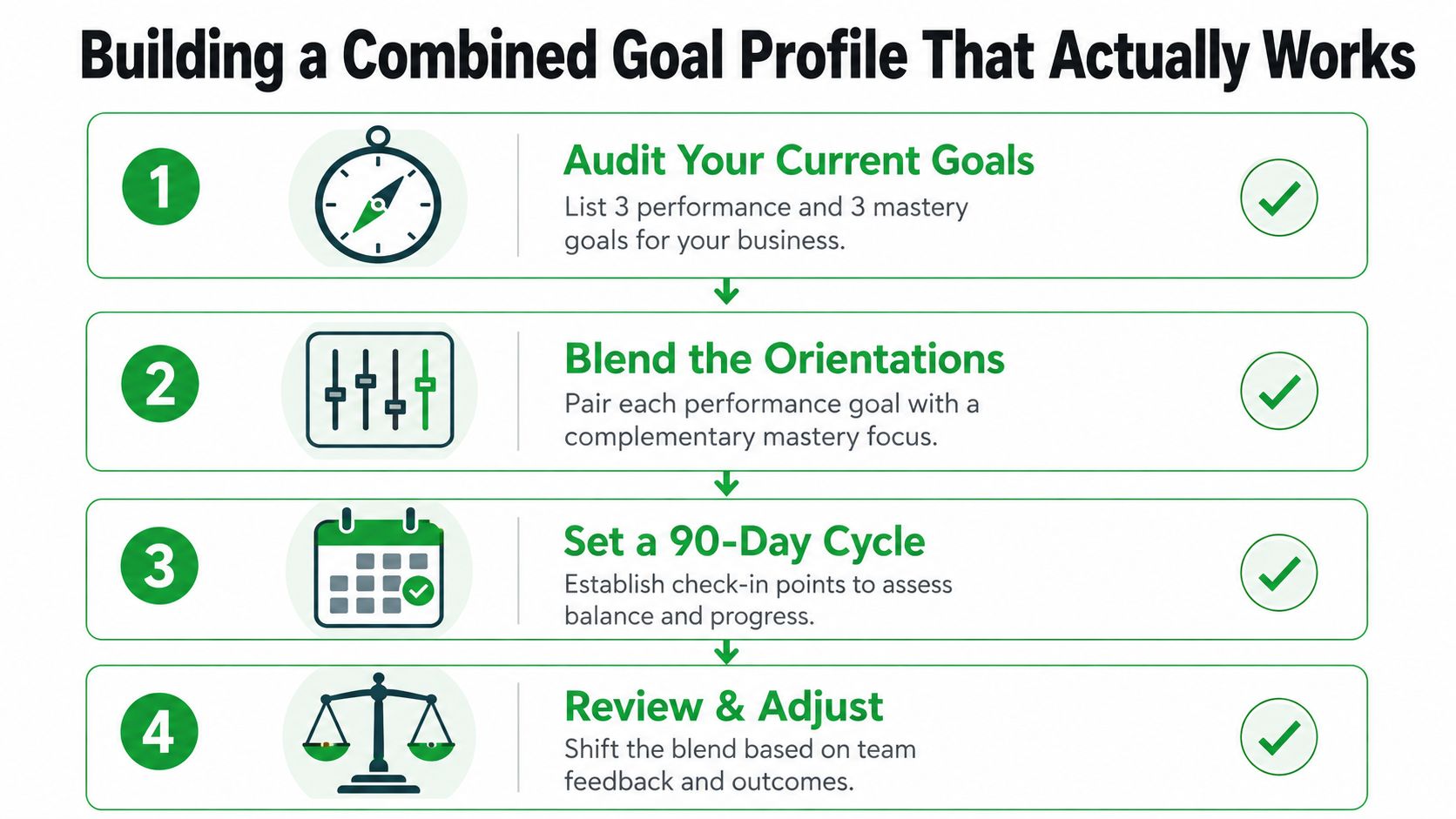
Weight the blend by role
A junior marketer should lean toward mastery. Their manager should care about research quality, message development, and learning from feedback, alongside a reasonable delivery expectation. A senior marketer should lean more toward performance because the business needs campaigns that produce an external result, not just better internal thinking.
Managers need both lenses at once. During one-on-ones, ask, “What capability improved?” and “What result changed?” If either answer is always missing, the profile is unbalanced.
You can apply the same logic to customer segments and website messaging. A team defining what are user personas should learn to distinguish audience needs, then connect that understanding to pages and calls to action that help real visitors decide.
Make these first-week moves:
- Rewrite each job objective so it contains one learning aim and one visible outcome.
- Add one learning KPI per quarter, such as a completed skill demonstration or documented process improvement.
- Review progress through both lenses in every one-on-one.
- Revisit the blend each quarter as the business, team, and customer expectations change.
A combined profile isn’t a compromise. It’s a better description of how competent businesses operate.
X8 Web Design can help turn this same balance into a website and content system that teaches prospective customers while making business outcomes visible. Visit X8 Web Design to discuss a conversion-focused website, SEO content strategy, or UX improvements that connect credibility with measurable action.